[2 Easy Ways] Where Do I Find My Scanned Documents on Windows 10/11

Are you wondering where do I find my scanned documents? Here is a detailed step-by-step guide that will help you find your scanned documents. Download 4DDiG Data Recovery to recover any lost scanned documents.

5 mins read

Updated on 2026-05-19 17:44:07 to Windows Fix

Are you wondering, where do I find my scanned documents on Windows 10/11? Many users run into the same problem after scanning files - they expect them to appear immediately, but end up not knowing where they were saved.

In most cases, this happens because scanning tools automatically store files in default folders, which are not always obvious at first glance. This guide will walk you through simple and effective ways to locate your scanned documents, no matter your level of computer experience. Let’s get started.

where do i find my scanned documents

Where Do I Find My Scanned Documents on Windows 10/11

If you're wondering where to find a scanned document on your computer, especially on Windows 10 or 11, this guide is for you. Scanning and saving documents is a common task, but locating them afterward can sometimes be confusing. Here are two simple methods to help you quickly find your scanned files.

Method 1. Check the Documents or Pictures Folder

The reason scanned documents are often hard to find is that many scanning applications on Windows 10/11 automatically save files to default system locations, usually the Documents or Pictures folder.

This "auto-save" behavior is designed for convenience, but it can cause confusion if users are unaware of the default save path. In most cases, your scanned files are already stored in one of these folders, so checking them first is the quickest way to locate your documents.

Here's how you can check the Documents or Pictures folder for your scanned files.

  • Open File Explorer' by clicking on the folder icon on your taskbar.
  • In the navigation pane on the left, click on 'This PC' or 'Quick Access'.
  • From there, navigate to either the 'Documents' or 'Pictures' folder. These folders are commonly used by scanning software as default save locations. where do I find my scanned documents
  • Browse through these folders, looking for a subfolder possibly labeled as 'Scans', 'Scanned Documents', or something similar. If you remember the file name or approximate date when you scanned the document, it can help narrow down your search.
  • If you find a folder dedicated to scans, open it to see if your document is there.

Method 2. Search for the Scanned Documents

Sometimes scanned documents can be difficult to locate, especially when your computer contains many files and folders. You may not remember the folder name or where the file was saved. In this case, the Windows search feature can help you quickly locate the document without manually checking every folder.

This method is particularly useful if the scanned file was saved in an unexpected location or mixed in with a large number of files. Follow the steps below to search for your scanned documents.

  • Press Windows + E to open File Explorer.
  • Type in what you remember about the document, like the name or 'scanned'. where do I find scanned documents on my PC
  • Press Enter to start the search, then browse the results to locate your document. If too many files appear, try using more specific keywords or include details such as the scan date to narrow down the results.

By using the methods above, you should be able to locate your scanned documents on your computer. However, if you're still asking yourself, where do I find my scanned documents, the files may have been accidentally deleted or lost.

Fortunately, there are still ways to recover missing scanned documents.

How to Recover Lost Scanned Documents on Windows 10/11

Your scanned documents may have been accidentally deleted, removed during cleanup, or lost after a system crash or storage issue. This is especially common when they are automatically saved to temporary or default folders that users rarely check or back up.

To recover missing scanned documents, you can use 4DDiG Data Recovery. Compatible with Windows 7/10/11, it can scan your local disk, external drives, USB devices, and SD cards for deleted or lost files. Here are other key features of 4DDiG that you may be interested in:

  • Recover Various File Types: Supports recovery of scanned PDFs, Word documents, Excel files, PPT, photos, videos, and many other file formats.
  • Multiple Device Support: Works with internal hard drives, external drives, USB flash drives, SD cards, and other storage devices.
  • Supports Multiple Data Loss Scenarios: Recovers files lost due to deletion, formatting, system crashes, corruption, or virus attacks.
  • Safe Recovery Process: Performs read-only recovery without overwriting or modifying existing data.
  • Preview Before Recovery: Allows you to preview recoverable files before restoring them to ensure accuracy.
  • Easy to Use: Designed with a simple and intuitive interface suitable for both beginners and advanced users.
  • Deep Scan Technology: Thoroughly scans storage devices to locate deleted, lost, or inaccessible scanned documents.

Now let's learn how you can use 4DDiG to get back your lost scanned documents.

FREE DOWNLOAD

Secure Download

FREE DOWNLOAD

Secure Download

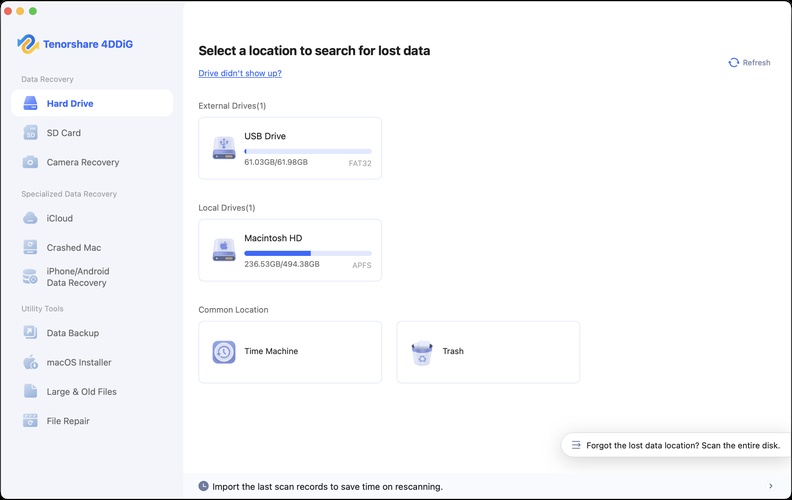
  • First, download and install 4DDiG on your computer and launch it. Now click on the local drive where you have lost your documents to begin.

    launch 4ddig and enter interface
  • The tool will begin scanning the selected local drive for all lost files. During the scan, you can switch between Tree View and File View to better locate specific files. Once you find the file you need, you can stop the scan early and proceed with recovery.

    how to use 4DDiG Data Recovery to recover lost scanned documents
  • Now preview the file to make sure it's intact. If everything looks correct, select it and click the "Recover" button.

    preview and recover the files
  • Click "Save Now" to choose a location for storing the recovered files. It is recommended to save them to a different drive or folder than the original one to avoid overwriting any remaining data.

    save the recoverable files

FAQs about Where Do I Find My Scanned Documents

1. Where do I find my scanned documents on my iPhone?

Here's how to find your scanned documents on an iPhone:

  • If you used the Notes app to scan the document, open the Notes app, and look for the note where you scanned the document.
  • If you used a third-party scanning app, open that app, and look in its document storage or library section.
  • Check the Photos app if you used your camera to take a picture of the document, as some scanning apps save scanned documents as images in your photo library.

2. Where do I find a scanned document on my Mac?

Here's how to find scanned documents on a Mac:

  • If you used Preview or other built-in macOS tools for scanning, the documents are likely saved in your Documents folder or on your Desktop.
  • If you used a third-party scanning app, open the app and look in its document storage or library.
  • Use Spotlight Search (press Command + Spacebar) to search for the document by name or file type.
  • Check the Downloads folder if you scanned the document using an online service or email attachment.

Final Thoughts

You may have been wondering, where do I find my scanned documents on your laptop. By now, you should have several effective ways to locate them—checking default folders and using the search tool will often help you find them quickly.

However, in some cases, files may still be missing or accidentally deleted. 4DDiG File Recovery is a tool designed to help you recover lost files from your computer and other storage devices when they cannot be found through normal methods.

So don't worry too much about losing scanned documents. With these simple tips and 4DDiG, you have a reliable way to get your files back.

FREE DOWNLOAD

Secure Download

FREE DOWNLOAD

Secure Download

William Bollson (senior editor)

William Bollson, the editor-in-chief of 4DDiG, devotes to providing the best solutions for Windows and Mac related issues, including data recovery, repair, error fixes.

(Click to rate this post)

You rated 4.5 ( participated)