How to Fix SD Card Not Mounting on Android/PC/Mac?

5 mins read

Updated on 2025-12-15 15:34:56 to SD Card

SD cards are widely used in cameras, phones, and other devices because they’re small, affordable, and able to store large amounts of data. However, like any storage device, they can run into problems.

One common issue is the SD card not mounting, where the card is inserted but your device can’t connect to it. When this happens, your files won’t show up, and you won’t be able to read or save anything on the card.

In this article, we’ll walk you through practical troubleshooting steps to get your SD card mounted again, along with safe data recovery options in case the card is corrupted or unreadable.

sd card not mounting

Mount & Unmount & Not Mounted SD Card Overview

Before diving in, it’s important to know the three basic states of an SD card: mounted, unmounted, or not mounted. These states show whether your device can access the card’s files, which helps in diagnosing problems and choosing the right solution.

What Does Mount SD Card Mean?

Mounting an SD card means connecting the card to your device so it can read and write files. When a card is mounted, your device recognizes it as usable storage.

What Does Unmount SD Card Mean?

Unmounting an SD card means safely disconnecting it from your device so no data is being read or written. Once unmounted, the card cannot be accessed until it is mounted again, which helps prevent file corruption.

What Does SD Card Not Mounted Mean?

“SD card not mounted” means the device sees the card but cannot connect to it, so you can’t access or use its files. This usually indicates a problem with the card, the device, or the connection between them.

Why My SD Card Won't Mount?

  • The SD card’s file system may be unsupported (e.g., NTFS) or corrupted, so the device can’t mount it.
  • File system corruption from improper ejection or power loss can prevent mounting.
  • Dirt, bent contacts, or a damaged slot/reader can block the connection.
  • Some devices don’t support certain card types or high-capacity SD cards.
  • Outdated drivers or OS issues can stop the card from mounting.
  • Improper or loose insertion can prevent a stable connection to mount the card.

How to Fix SD Card Not Mounting on Android?

If your Android phone won’t mount your SD card, it doesn’t always mean the card is dead, sometimes a quick fix can get things working again. In the section, we’ll show you effective steps you can try to restore access to your SD card.

Before that, you can start with the simplest solutions first.

  • Try restarting your phone, then remove and reinsert the SD card to ensure it’s properly seated.
  • You can also gently clean the card and the card slot to remove any dust or debris that might be preventing a good connection.
  • Remove the SD card from your device. Insert it into another phone, tablet, or card reader, then check if it can be read or mounted there.
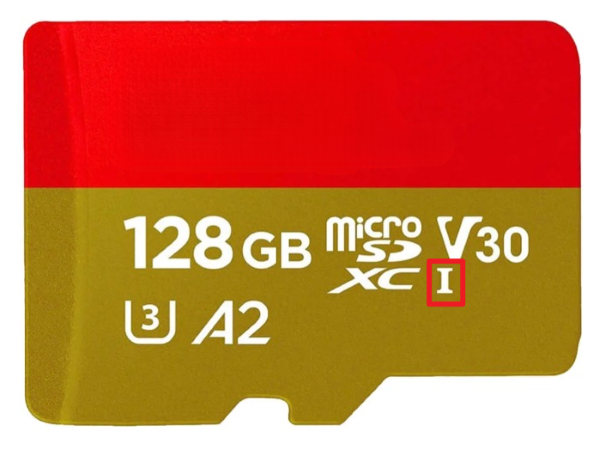
  • Verify the SD card type (SD, SDHC, SDXC) and capacity. Check your device specifications to ensure it supports that type and capacity.

If these initial steps don’t work, you can move on to more advanced solutions.

Method 1: Mount the SD Card Manually in Settings

If your Android device fails to detect the SD card automatically, you can try mounting it manually through the system settings, this often resolves the SD card not mounted errors without needing technical tools. Let's see how to mount SD card via Settings.

  • Open Settings on your Android device.
  • Go to "Storage" on your device.
  • Look for your SD card and tap “Mount SD card”. mount the sd card on android
  • Following this step will solve the software issue and make the SD card accessible again.

Method 2: Clear Cache of Storage or Related Apps

Sometimes, cached data in your storage system or related apps can prevent your device from recognizing an SD card. Clearing the cache can refresh the system and help the SD card mount properly.

  • Open the Settings app on your Android device.
  • Go to "Apps" (or Apps & notifications, depending on your device).
  • Find and tap "Storage" or the app that manages storage/files.
  • Select Clear cache. clear cache sd card on android
  • Once done, restart your device and check if the SD card is recognized.

Method 3: Format the SD Card

If you fail to mount SD card using the above method, formatting it can reset its file system and resolve mounting issues. Just remember: formatting will erase everything on the card, so back up any important files first.

It's ok if you forget to back up all the important files as you use 4DDiG Data Recovery to recover files from a formatted SD card.

  • Open the Settings app on your Android device.
  • Tap "Storage", then select your SD card from the list of storage options.
  • Tap the three-dot icon or More options, then choose "Format". format sd card on android
  • Confirm the action and wait for the formatting process to complete.
  • Once done, the SD card should be blank and ready to use.

Method 4: Replace the SD Card if It’s Damaged

If you are still unable to mount SD card on Android, even after trying cleaning, mounting manually, formatting, or testing on another device, the problem may lie in physical damage. In such cases, replacing the SD card is often the safest and most reliable solution.

How to Fix SD Card Not Mounting on Windows?

If your SD card not mounting on your Windows PC, don’t panic. Below are some common solutions to help you diagnose and restore access to your SD card.

Start with the simplest fixes first. Restart your computer, then remove and reinsert the SD card or try a different card reader to ensure a proper connection. You can also test the SD card on another computer to see if it’s recognized. If these steps don’t resolve the issue, you can move on to the more advanced solutions.

Method 1: Assign or Change Drive Letter in Disk Management

If your SD card isn’t mounting on Windows (meaning it doesn’t appear in File Explorer), the issue may be that it has no drive letter or the current letter conflicts with another device. Assigning or changing the drive letter can often restore access and make the SD card usable again.

  • Right-click the Start button and select "Disk Management". click disk management on windows
  • Locate your SD card in the list of drives (usually labeled as “Removable”).
  • Right-click the SD card partition and select “Change Drive Letter and Paths…”. change driver letter and paths sd card
  • Click Add (if no letter is assigned) or Change (to modify an existing letter). add drive letter or path sd card
  • Choose a new drive letter (e.g., D, E, F) and click OK to apply.

Method 2: Update or Reinstall SD Card Drivers

Sometimes the reason your SD card not mounted is simply that the driver managing the card reader is outdated, corrupted, or missing. Updating or reinstalling the driver can restore proper communication between Windows and the card, allowing it to mount again.

  • Right-click the Start button and select "Device Manager". open the device manager
  • Expand Portable Devices, right-click your SD card and select "Update driver". update driver sd card windows
  • Choose "Search automatically for drivers" and let Windows install updates if available. search automatically for drivers windows
  • After that, reconnect your SD card and check if it appears in File Explorer

Method 3: Run CHKDSK to Repair File System Errors

If your SD card isn’t mounting, it could have file system errors that prevent Windows from reading it. Running CHKDSK scans and repairs logical errors, which often restores access to the card.

  • Insert the SD card into your computer.
  • Open File Explorer by pressing Win + E and note the drive letter of your SD card.
  • Search for Command Prompt on the Search bar and click "Run as administrator". run command prompt as administrator
  • Type chkdsk X: /f (replace X with your SD card’s drive letter) and press Enter. run the chkdsk prompt
  • Wait for CHKDSK to scan and repair any errors. Then, check if your SD card can be mounted.

Method 4: Format the SD Card

If all previous troubleshooting methods fail, formatting the SD card is your final option. This process wipes everything on the card and rebuilds the file system, which can fix deep-level corruption. Make sure to back up any recoverable data before proceeding.

  • Insert the SD card into your computer using the built-in slot or a card reader.
  • Open File Explorer by pressing Win + E and locate your not-mounted SD card.
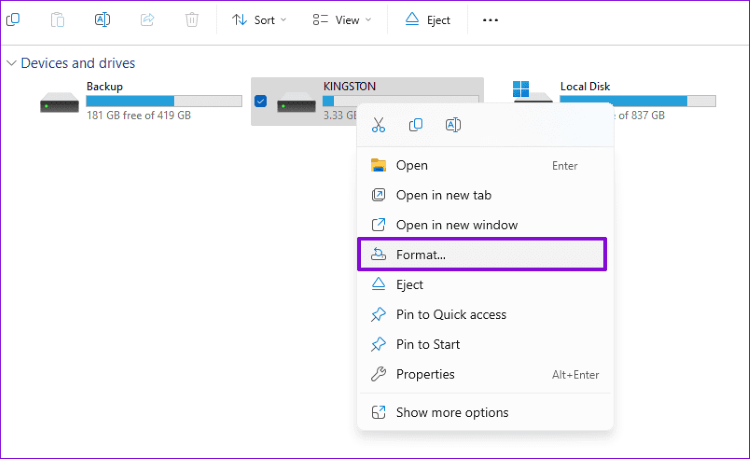
  • Right-click the SD card and choose "Format". format sd card via file explorer
  • Select a File System (FAT32 for cards ≤32GB, exFAT for larger cards) for it. You can keep Quick Format enabled unless you prefer a full scan. quick format sd card via file explorer
  • Click "Start" to begin formatting. When done, click "OK" and safely eject the SD card.

How to Fix SD Card Not Mounting on Mac?

If the SD card works on other devices but won’t mount on your Mac, the issue may be related to macOS settings, file system compatibility, or hardware recognition. To resolve this issue, you can start with the simplest checks.

Restart your Mac to clear temporary glitches, then remove and reinsert the SD card to ensure a proper connection. If it still doesn’t appear, try using a different SD card reader or plug it into another USB port to confirm whether the issue lies with the SD card, the reader, or the Mac’s hardware. When they didn't work, try the following solutions.

Method 1: Check the Finder Settings

Sometimes the SD card is actually recognized by your Mac but simply isn’t set to appear in Finder. Adjusting these preferences ensures the SD card is visible and can be mounted.

  • Open Finder on your Mac. In the top menu bar, click Finder > Settings (or Preferences on older macOS versions).
  • Go to the General tab. Under “Show these items on the desktop,” make sure "External disks" is checked. show these items on the desktop
  • Switch to the Sidebar tab. Under Locations, ensure External disks is enabled so the SD card appears in the Finder sidebar.

Method 2: Run First Aid to Repair the SD Card

SD card won’t mount even though it's detected? macOS’s First Aid tool can scan and repair file system errors that may be preventing proper mounting. This is a safe, built-in fix and should be tried before formatting the card.

  • Using Spotlight to open Disk Utility.
  • In the sidebar, select View > Show All Devices". disk utility show all devices
  • Click "First Aid" in the top toolbar, select "Run" when prompted. run first aid on sd card
  • Wait for the scan and repair process to complete.
  • After it finishes, try mounting the SD card again.

Method 3: Update macOS

Sometimes an outdated macOS version can cause compatibility issues with external storage devices, including SD cards. Updating your system ensures you have the latest drivers and bug fixes that may resolve mounting problems.

  • Click the Apple menu and select "System Settings". apple system settings
  • Go to "General > Software Update". click to upgrade macos
  • If an update is available, click "Update Now" or "Upgrade Now ".
  • Restart your Mac after the update completes. Reinsert the SD card and check if it mounts normally.

Method 4: Format the SD Card on Mac

If none of the previous methods work, the SD card may have severe file system corruption. Formatting it can restore functionality, but it will erase all data. Make sure you back up anything recoverable before proceeding.

Once complete, eject and reconnect the card to check if it mounts.
  • Insert the SD card into your Mac. Go to "Applications > Utilities" to access "Disk Utility".
  • Select your SD card from the left sidebar, then click "Erase" at the top. click to erase the sd card
  • Choose a format for the SD card then enter a name to start formatting.
  • Once complete, eject and reconnect the card to check if it mounts.

How to Recover Data from Formatted SD Card?

If you had to format your SD card to fix mounting issues, don’t worry, formatting doesn’t always mean your data is gone forever. In many cases, files can still be recovered using specialized tools.

One reliable option is Tenorshare 4DDiG Data Recovery, a powerful software that can scan formatted SD cards and restore photos, videos, documents, and more with ease. Using 4DDiG, you can recover lost files quickly and safely, even after severe file system errors or accidental formatting.

FREE DOWNLOAD

Secure Download

FREE DOWNLOAD

Secure Download

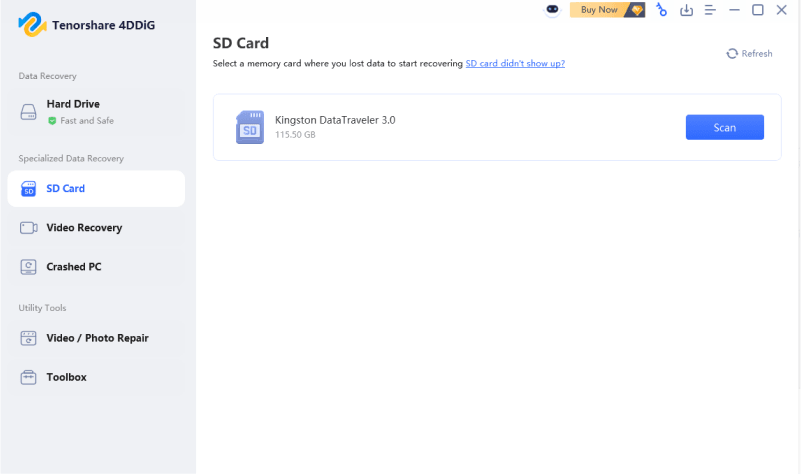
  • Download and install Tenorshare 4DDiG on your PC or Mac. Run the tool, get your SD Card connected, select the "SD Card" tab from the interface, and hit the “Scan” button. click sd card tab
  • This software will scan the SD card to find the lost data. Wait for the process to complete and click "Recover". wait for 4ddig to scan
  • Once the lost files are found, select the desired files you want to have a preview. Then, click on the "Recover" button to get the desired files back and select the location to save the files. click recover for lost files

That’s it! You’ve successfully retrieved all the lost files from your SD card using 4DDiG. You can now check your recovered files, but be sure not to save them back to the same partition where the data was lost. Here’s what makes 4DDiG exceptional:

  • 📄 Extensive File Type Support: 4DDiG can recover over 2,000 file types, including photos, videos, documents, audio, archives, and more.
  • 🎯 SD Card Compatibility: It works with all major SD card formats such as FAT16, FAT32, exFAT, NTFS, HFS+, APFS, and others.
  • 💾 RAW and Damaged SD Card Recovery: Even if your SD card appears as RAW or unreadable, 4DDiG can repair the file system and safely recover your files.
  • ☺️ User-Friendly Interface: Its clean and intuitive design makes the recovery process simple for both beginners and experienced users.
  • ✨Preview Before Recovery: 4DDiG allows you to preview all recoverable files, so you can selectively restore only the files you need.

Conclusion

The SD card not mounting error is a common one that many users face. Moreover, there is no other way than the above to solve this error. The final solution to this problem is to format the SD card. In case you don't have a backup and need to recover all the lost files, Tenorshare 4DDiG can be your best option.

FREE DOWNLOAD

Secure Download

FREE DOWNLOAD

Secure Download

William Bollson (senior editor)

William Bollson, the editor-in-chief of 4DDiG, devotes to providing the best solutions for Windows and Mac related issues, including data recovery, repair, error fixes.

(Click to rate this post)

You rated 4.5 ( participated)