How to Remove Write Protection from SD Card Without Damaging Data?

5 mins read

Updated on 2026-02-10 19:41:10 to SD Card

Imagine trying to save important data on your SD card, only to discover it’s write-protected. This means you can’t delete, add, or modify any files on the card, no matter what you try. Many users are caught off guard and frustrated when they encounter this error while working with their SD cards.

Fortunately, removing write protection from an SD card is not as complicated as it seems. In this guide, we’ll explain everything you need to know about SD card write protection and show you how to remove write protection from SD card safely without damaging data.

how to remove write protection from sd card

What Does SD Card Is Write Protected Mean?

When an SD card is write-protected, it means you can’t make any changes to the files on it. You won’t be able to add new files, delete existing ones, or edit anything already stored.

Basically, the SD card is in a read-only mode. This is why, when you try to save or modify something, you might see an error saying the card is write-protected.

In simple terms, the SD card lets you look at your files, but not change them, at least until you remove the write protection.

What Causes Write Protection on an SD Card?

Write protection on an SD card is a built-in feature designed to prevent accidental deletion or data loss. However, sometimes you might encounter this issue unexpectedly. Here are some of the most common reasons why an SD card becomes write-protected:

  • 📌 Physical Lock Switch is On: Many SD cards have a tiny switch on the side. If it’s set to “Lock,” the card becomes read-only and the write protection mode is enabled.
  • 📁 File System Errors: Corrupted or damaged file systems can trigger write-protection to prevent further data loss.
  • ☠️ Virus or Malware: Malicious software can lock the SD card, making it impossible to modify or delete files.
  • 💾 Full Storage: Some cards may act like they’re write-protected if the storage is completely full.
  • 🔨 Damaged SD Card: Hardware failure can cause the card to become read-only.

In this situation, the only way to use your micro SD card normally again is to remove its write protection.

How to Recover Data from a Write-protected SD Card?

Even though write protection doesn’t automatically mean your files are gone, in some cases, underlying corruption or damage can put your data at real risk. When you’re unable to access your files normally, the next step is figuring out how to recover data from a write‑protected SD card safely.

One tool many people turn to for this kind of situation is 4DDiG Data Recovery, a data recovery software that can scan and restore files from formatted/corrupted/inaccessible SD cards. It lets you preview recoverable files before recovery, so you have a chance to retrieve what’s important even when you can’t access the card directly.

FREE DOWNLOAD

Secure Download

FREE DOWNLOAD

Secure Download

Why you should choose 4DDiG for data recovery:

  • Broad File Type Support: Recovers a wide range of file formats including photos, videos, documents, emails, archives, and more, helping you retrieve almost anything you lost.
  • Multiple Storage Devices: Works with SD cards, microSD, USB drives, hard drives, SSDs, and other external media, so you can use it across different devices.
  • Extensive File & Device Support: Can handle recovery from formatted SD cards, corrupted partitions, virus damage, and other data loss scenari os you might encounter on SD cards.
  • 2 Scan Modes: Offers both quick scans for recent losses and deep scans to locate files in more complex situations like formatted or corrupted cards.
  • Easy to Use Interface: A user-friendly design guides you step-by-step through recovery, even if you’re not technically experienced.

How to use 4DDiG for retriving data from an SD card:

  • Launch 4DDiG and connect the formatted SD card to the PC. Then navigate to the SD card tab and hit "Scan". sd card recovery software free
  • Now, 4DDiG will start scanning the SD card to find your inaccessible data. Once the scanning process is done, you can see all the results. click type to see all files 4ddig
  • You can use the filter to locate the files for recovery. Clcik on it to have a quick preview and hit "Recover" button. preview and recover the files
  • If you've chosen the files to recover, proceed to choose a location to store all the recoverable files, then click "Save Now". save the recoverable files

How to Remove Write Protection from SD Card?

Below are a few handy solutions to disable write protection on SD card safely and quickly. Let's see how they work, choose the one that works for you.


1 Check Your SD Card Lock Switch

Most SD cards come with a small lock switch on the left side that controls write protection. Start by ejecting the card and checking that the switch is set to the unlocked position (usually slid upward).

check sd card switch to remover sd card write protection

If the switch is already away from the Lock position, you can move on to the next solution.

2 Remove SD Card Write Protection Using CMD

You can also remove write protection on SD card manually using the Command Prompt. This method is straightforward, requires no extra software, and usually takes just a few seconds to complete.

By running a few simple commands, you can clear the write-protection attribute and regain full access to your SD card. Check out how to turn off write protection on SD card using CMD:

  • Hit Window + X keys simultaneously to open the command window. Here, enter “diskpart” and hit OK. use cmd to remover write protection from sd card
  • Now, run the command “list disk” and locate your SD card from the list. Remember its disk number.
  • Next, run the command, "select disk number” and replace “number” with your “disk number.”
  • Finally, enter the command, “attributes disk clear readonly” and hit Enter. The program will clear the write-protected error successfully. enter command and cmd will clear write protection error
Notes

Using Command Prompt to remove write protection is an effective option, but it requires extra caution. Entering the wrong commands can cause data loss or even make your SD card unusable.

3 Use Registry Editor to Fix SD Card Write Protection

Still seeing the write-protection error? You can try resolving the issue by adjusting the Windows Registry. This method can be effective, but it’s important to follow each step carefully, as incorrect changes to the Registry may cause system issues. Follow to unwrite protect the SD card:

  • After connecting your SD card to a PC, hit “Windows + R” to bring up the "Run" window.
  • Now, type in “regedit”, hit Enter, and select Yes to open Registry Editor.
  • Here, expand the folder in the left panel as the following path: “HKEY_LOCAL_MACHINE\SYSTEM\CurrentControlSet\Control.” Then, click the StorageDevicePolicies folder. If you don't see this folder, right-click Control folder and select New > Key to create a new key called StorageDevicePolicies. remove sd card write protection with windows registry
  • After that, double-click the “WriteProtect” key, set its value data to 0. Hit Ok to proceed.
  • Close the Registry editor, remove your SD card, and restart your PC.
Notes

The Registry Editor is a powerful tool and should be used with care. Changing the wrong settings can lead to serious system issues, so it’s strongly recommended to back up your data before making any modifications.

4 Run CHKDSK

Running CHKDSK is especially helpful if your SD card is corrupted or keeps getting stuck when writing data. Using the CHKDSK utility, you can scan the card for file system errors and fix common issues that may be triggering the write-protection problem. Follow the steps below to identify and repair these errors safely.

  • Search command prompt, right-click “Command Prompt”, and run it as administrator.
  • Now, run the command, “chkdsk /f /r” with the drive letter of the SD card. For instance, chkdsk h: /f /r. Run CHKDSK to check sd card corruption
  • The program will automatically fix the errors and bad patches on your SD card.

5 Check SD Card Virus or Malware

SD cards are especially vulnerable to malware, particularly when files are transferred between different devices. Fortunately, the fix is simple: scan your SD card with a reliable, licensed antivirus program to detect and remove any threats that may be causing the issue.

6 Unlock the Write Protection SD Card with Decryption Software

One of the easiest ways to disable write protection on SD card is by using decryption software. There are plenty of SD card write protection removal tools available online that can help unlock the card and remove write protection with minimal effort. Simply choose a reliable program, decrypt the SD card, and you’ll be able to use it normally again.

7 Format Your SD Card

If you SD card or its files are severely corrupt, then consider formatting your data. Formatting wipes out all the data stored on it as well as removes any type of malware in the card. This is also an option to release write protected on an SD card, but it's recommended to back up or restore data first before attempting to format your SD card.

  • Insert the SD card into your computer using a card reader.
  • Open File Explorer by pressing Windows + E and go to "This PC".
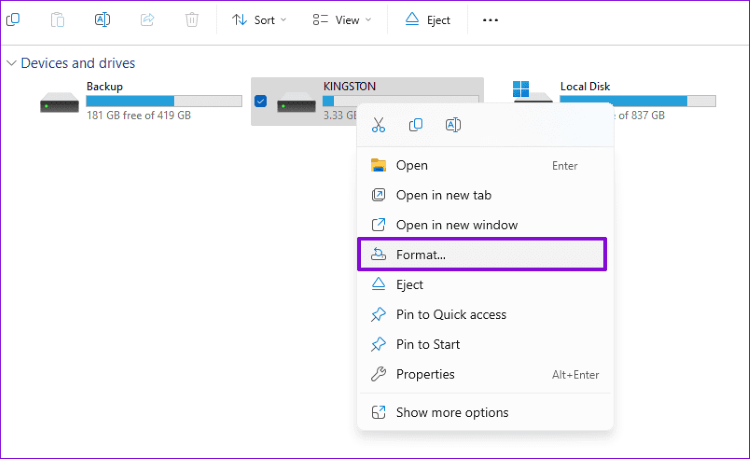
  • Locate your SD card in the list of drives. Right-click on it and select "Format" from the menu. format sd card via file explorer
  • In the Format window, choose the File System (FAT32 for cards ≤32GB, exFAT for larger cards). Keep the Allocation Unit Size as default. Optionally, check Quick Format for faster formatting. quick format sd card via file explorer
  • Click "Start", then confirm any warning messages. Wait for the formatting process to complete.

8 Replace with a New SD Card

If none of the methods above work, it’s likely that your SD card is damaged beyond repair. In this case, the only option is to replace it with a new card.

Unfortunately, any data remaining on the old card will be lost, so it’s important to ensure you’ve attempted recovery or backups before reaching this point. Once you have a new SD card, you can continue storing and transferring your files without interruption.

replace a new sd card

Why You Should Remove SD Card Write Protection?

Removing write protection from an SD card is important because it restores your ability to add, delete, or modify files on the card. When a card is write-protected, you can only view the data, which can be frustrating if you need to save new files, update existing ones, or free up space.

By removing write protection, you regain full control over your SD card, ensuring it can be used normally for storage, transfers, and regular device operations.

Conclusion

With the solutions outlined in this guide, removing write protection from an SD card on Windows should be straightforward. Just make sure to follow each step carefully, especially when editing the Windows Registry or using Command Prompt. If you’ve lost any important data during the process, 4DDiG Windows Data Recovery can help you recover it quickly and safely.

FREE DOWNLOAD

Secure Download

FREE DOWNLOAD

Secure Download

William Bollson (senior editor)

William Bollson, the editor-in-chief of 4DDiG, devotes to providing the best solutions for Windows and Mac related issues, including data recovery, repair, error fixes.

(Click to rate this post)

You rated 4.5 ( participated)