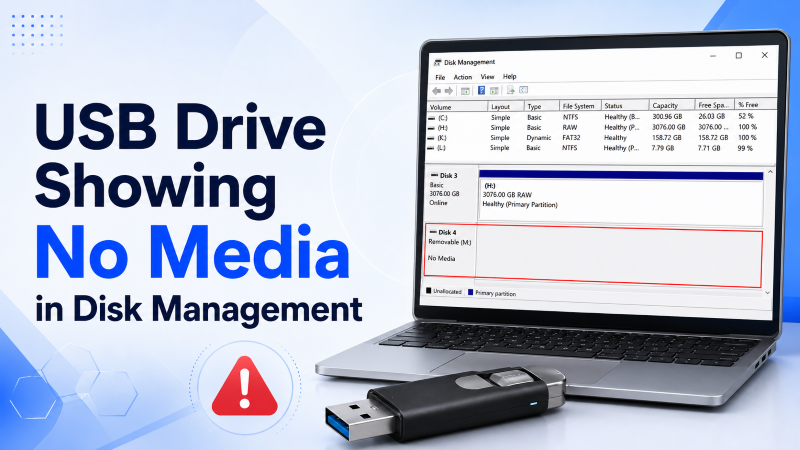
10 Ways to Fix USB Drive Not Showing Up on Windows 10/11

5 mins read

Updated on 2026-04-17 15:36:11 to USB Recovery

How to fix USB drive not showing up on 10/11?

"The issue with my USB started when I was moving some files from my computer to the USB. Suddenly my transfer failed and the USB stopped showing on my computer. Is there any simple way please to fix it?"

A USB stick is a handy tool that allows you to carry a large amount of data. It's basically like a mini portable hard drive. Naturally, a device with so many functions can sometimes run into issues.

Today, we're going to talk about one common problem—your USB drive not showing up on your PC. Yes, this can happen for various reasons. But don't worry, as this issue is usually fixable and can often be resolved quite easily.

In this article, we'll walk you through different effective ways to solve this problem, from simple physical checks to more advanced solutions. So be sure to follow each method carefully and apply the fixes correctly.

usb drive not showing up on windows 10 11

Why Is My USB Drive Not Showing Up?

In most cases, your jump drive or USB not showing up in Windows 10/11 is caused by minor issues that are often overlooked. Over time, these small problems can build up and eventually lead to bigger issues. The most common reasons why your flash drive doesn’t show up on your PC include:

  • Faulty or loose USB connection: The USB may not be properly connected, or the cable or port could be unstable.
  • Damaged USB port: A malfunctioning USB port can prevent your device from being detected.
  • Corrupted or outdated USB drivers: Missing, outdated, or corrupted drivers may cause Windows to fail to recognize the USB drive.
  • Drive letter not assigned or conflicting: The USB may not appear if it lacks a drive letter or conflicts with another drive.
  • File system errors or corruption: A corrupted file system can make the USB inaccessible or invisible.
  • USB drive not initialized or partitioned: New or improperly configured drives won’t show up until they are initialized.
  • Hidden or disabled device in Disk Management: The USB drive may be disabled or hidden in system settings.
  • Physical damage to the USB drive: Hardware damage may prevent the system from detecting the device.

How to Fix USB Not Showing Up on Windows 10/11?

How to Fix a USB Drive Not Showing Up in File Explorer but in Disk Management?

If your USB drive appears in Disk Management but not in File Explorer, it means the system detects it but can’t access it properly. Here are some quick fixes to make it show up again.

Fix 1: Run Windows Hardware and Devices Troubleshooter

If you're not sure what's causing the issue, Windows has a built-in tool that can automatically detect and fix common hardware problems.

The Hardware and Devices Troubleshooter is a quick way to identify system-related issues that may prevent your USB drive from being recognized.

  • Press Win + R to open the Run dialog box, then type msdt.exe -id DeviceDiagnostic and press Enter.

    windows hardware and devices troubleshooter window
  • When the Hardware and Devices Troubleshooter window appears, click "Next" to start the scan.

    troubleshoot hardware and devices
  • Wait while Windows automatically detects and fixes hardware-related issues.

  • Restart your PC if required after the troubleshooting process is completed.

Fix 2: Update USB Drive Driver

If it's been a long time since you have updated your USB drivers then it's probably time to update them as it may lead to your computer not recognizing usb. To do that:

  • Plug in your USB and go to "This PC > Properties > Device Manager".

    go to device manager
  • Once in the Device Manager, expand disk drives, find the problematic USB and right click on it to select "Update Driver".

    update usb driver device manager
  • You can select the "Search automatically for drivers" on the following screen.

    search automatically for drivers device manager
  • Let the driver update. Reboot your PC and try connecting the USB again.

Fix 3: Uninstall and Reinstall the USB Drive

If updating the USB drivers doesn't resolve the issue, the problem may be caused by a corrupted or improperly installed driver. In this case, uninstalling and reinstalling the USB driver can help reset it.

  • Plug in your USB and right-click "Start button > Device Manager".

    open the device manager
  • Next, expand disk drives, find the hidden USB drive and right click on it to select "Uninstall device".

    uninstall usb in device manager
  • Click "Uninstall" and wait for the process to complete. Once it's finished, restart your PC. After rebooting, Windows will automatically reinstall the USB driver.

    confirm to uninstall usb

Fix 4: Assign or Change Drive Letter

If your USB drive is still not appearing in File Explorer but shows up in Disk Management, the issue is often related to a missing or conflicting drive letter. In many cases, simply assigning or changing the drive letter can make the drive visible again. Follow here:

  • Press Win + X and select Disk Management from the menu.

    open the disk management window
  • Locate your USB drive, right-click the USB partition and choose "Change Drive Letter and Paths".

    click change drive letter and paths
  • Click "Add" if no drive letter is assigned, or click "Change" to modify the existing one.

    click assign the following drive letter
  • Select a new drive letter from the dropdown list.

  • Click OK to confirm and apply the changes.

Fix 5: Recover Data and Format the USB Drive

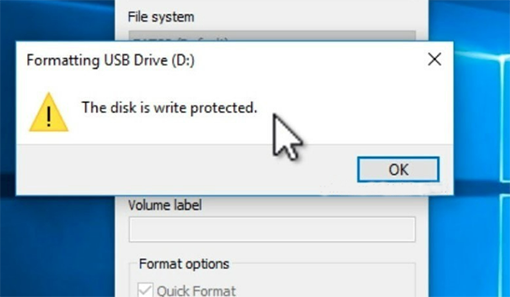
A flash drive not showing up in Windows 10/11 may be related to file system errors that make its data inaccessible. This issue is usually solved by formatting the drive. However, if your USB contains important files, formatting will cause all data to be lost.

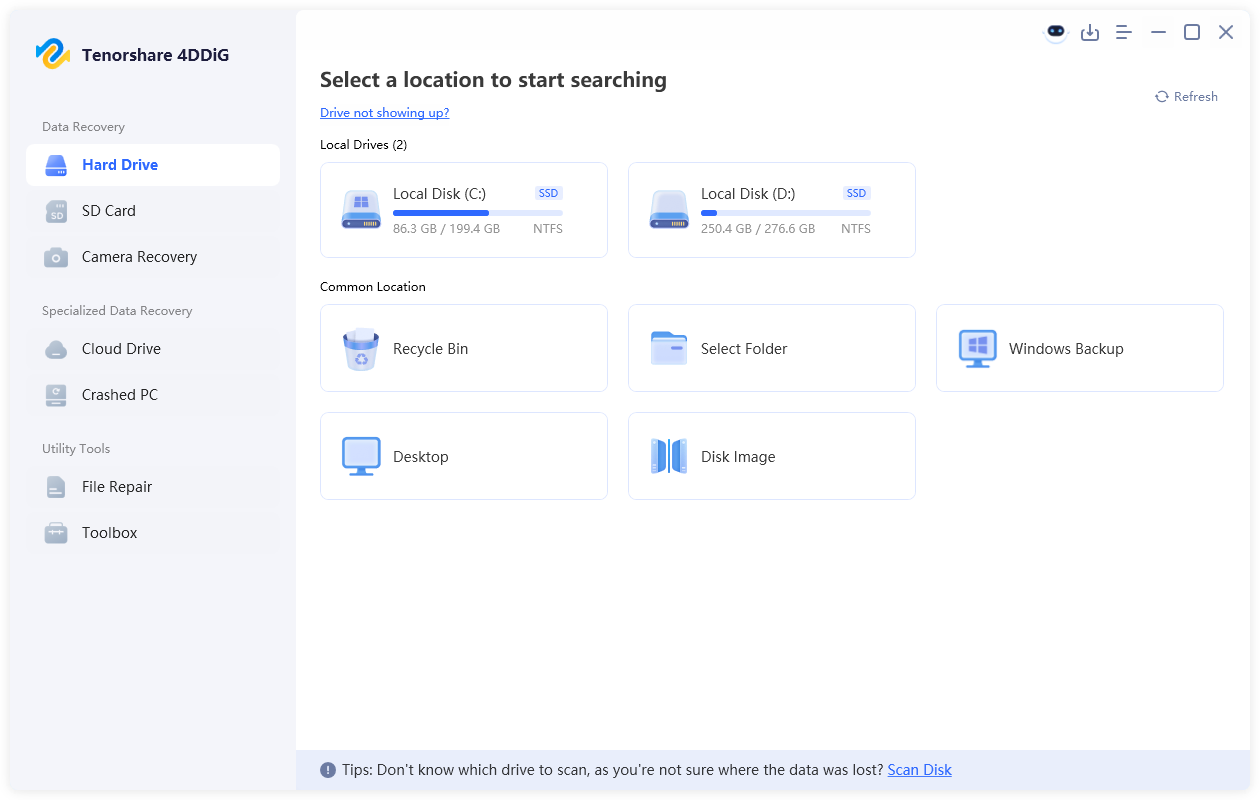
Therefore, you need a reliable tool that can recover data from the USB drive even when it is inaccessible. One such tool is Tenorshare 4DDiG. It is highly effective for recovering data, even from inaccessible USB drives. Some of its key features include:

  • Supports multiple data loss scenarios: Recovers data lost due to accidental deletion, formatting, corruption, or RAW drives.
  • Deep scan for inaccessible files: Performs a thorough scan to locate deleted, hidden, or lost data on corrupted or unrecognized drives.
  • Wide device compatibility: Supports data recovery from USB drives, SD cards, external hard drives, and other storage devices on PC and Mac.
  • Data recovery from crashed systems: Allows recovery from crashed or unbootable computers.
  • Wide file type support: Recovers a broad range of file types, including photos, videos, documents, audio files, and more.
  • Photo and video repair: Repairs corrupted or damaged photos and videos during the recovery process.
FREE DOWNLOAD

Secure Download

FREE DOWNLOAD

Secure Download

  • Install and open 4DDiG on your computer. Connect your USB drive to PC and click on it to begin scanning.

    launch 4ddig and enter interface
  • Wait for the process to finish. After the scanning, you can see all the existing files as well as any lost files on USB drive.

    click type to see all files 4ddig
  • After the scan, you can use the Filter or Search feature to find the files you want to recover and have a quick preview. Then, you can select them and click the "Recover" option.

    preview and recover the files
  • When prompted, choose a location different from your USB drive to save the recovered files to avoid overwriting data.

    save the recoverable files

After data recovery, you can safely format ySour USB drive. Here's how you can do:

  • Press Win + X and select Disk Management.

  • Locate your USB drive in the list of disks and right-click its partition.

  • Select "Format" from the menu, choose the file system (NTFS, exFAT, or FAT32) and click OK.

  • Locate your USB drive in the list of disks and right-click its partition.

  • Wait for the formatting process to complete. After that, the USB drive will be ready to use.

Fix 6: Initialize the USB Drive

If changing the drive letter doesn't bring the USB drive back in File Explorer, the problem may go deeper. In some cases, the disk is not properly initialized, which prevents Windows from taking it as a usable storage device. To fix this, you can try to the USB drive:

  • Press Win + X and select Disk Management.

  • Locate the USB drive that shows as "Unknown" or "Not Initialized".

  • Right-click the disk (not the partition) and select "Initialize Disk".

    initialize disk disk management
  • Choose a partition style: MBR or GPT, then click OK.

    select the partition style
  • Wait for the initialization process to complete.

  • After initialization, right-click the unallocated space and proceed to create a new volume if needed.

Fix 7: Create New Partitions

If the USB drive still shows as unallocated after initialization, there is no usable partition left on the disk. This is usually the final fix, but it will erase all existing data on the drive. To proceed, you need to create a new partition by following the steps below:

  • Open Disk Management by pressing Win + X and selecting Disk Management.

    open the disk management window
  • Locate the USB drive that shows as "Unallocated".

  • Right-click the unallocated space and select "New Simple Volume".

    click to create new simple volume
  • Click Next to start the New Simple Volume Wizard.

  • Set the volume size (or use the default maximum size) and click Next.

    specify the simple volume size
  • Assign a drive letter to the USB drive and click Next.

    assign drive letter or path
  • Choose a file system (NTFS, exFAT, or FAT32) and complete the formatting process.

    format the partition settings
  • Click Finish to complete the partition setup.

How to Fix USB Drive Not Showing up in File Explorer and Disk Management?

If your USB drive is not showing up in either File Explorer or Disk Management, the issue is usually more serious and you may need to try other troubleshooting methods.

Fix 1: Change USB Connection

A faulty USB connection, caused either by a defective USB drive or a damaged PC USB port, is a common reason for the USB drive not showing up in Windows 11 issue.

To identify the problem, try plugging the USB drive into another computer to see if it works properly. Also, make sure the USB drive is properly connected and compatible with the device you are using. This helps rule out any basic physical issues that may be causing the USB drive not to appear.

Fix 2: Enable Flash Drive in BIOS Setup

Another effective way to fix the USB drive not showing up in Windows 10/11 issue is to enable USB support in the BIOS. In some cases, USB ports may be disabled at the system level, preventing the flash drive from being detected by Windows. To do so:

  • Restart your PC and enter the BIOS setup by pressing the correct key during startup (such as F2, F10, Del, or Esc, depending on your manufacturer).

  • Once inside the BIOS menu, navigate to the Advanced or Integrated Peripherals section using your keyboard.

  • Look for an option such as USB Configuration or USB Controller and set it to Enabled.

  • Press F10 to save the changes and exit BIOS. Your computer will restart automatically, and USB ports will be enabled.

Fix 3: Disable USB Selective Suspend Feature

Windows PCs have a built-in power-saving feature called USB Selective Suspend, which temporarily turns off USB ports when they are not in use. However, this feature can sometimes cause your external USB drive not to show up on your PC. To disable this feature:

  • In the Windows Search box, type "Edit Power Plan", click on it to open the Power Options Control Panel window.

    edit power plan
  • Click "Change advanced power settings." In the new window, scroll down and double-click "USB settings" to expand the section. Then, expand "USB selective suspend setting."

    click change advanced power settings
  • Set it to "Disabled", then click Apply and OK to save the changes and close the window.

    disable usb selective suspend

Conclusion

You came in with a simple question: why is my USB drive not showing up? We have covered all possible solutions in this guide. From updating drivers to using third-party tools like the 4DDiG Data Recovery, you can choose the method that best fits your situation to fix the USB drive not showing up issue in Windows 10/11.

FREE DOWNLOAD

Secure Download

FREE DOWNLOAD

Secure Download

William Bollson (senior editor)

William Bollson, the editor-in-chief of 4DDiG, devotes to providing the best solutions for Windows and Mac related issues, including data recovery, repair, error fixes.

(Click to rate this post)

You rated 4.5 ( participated)